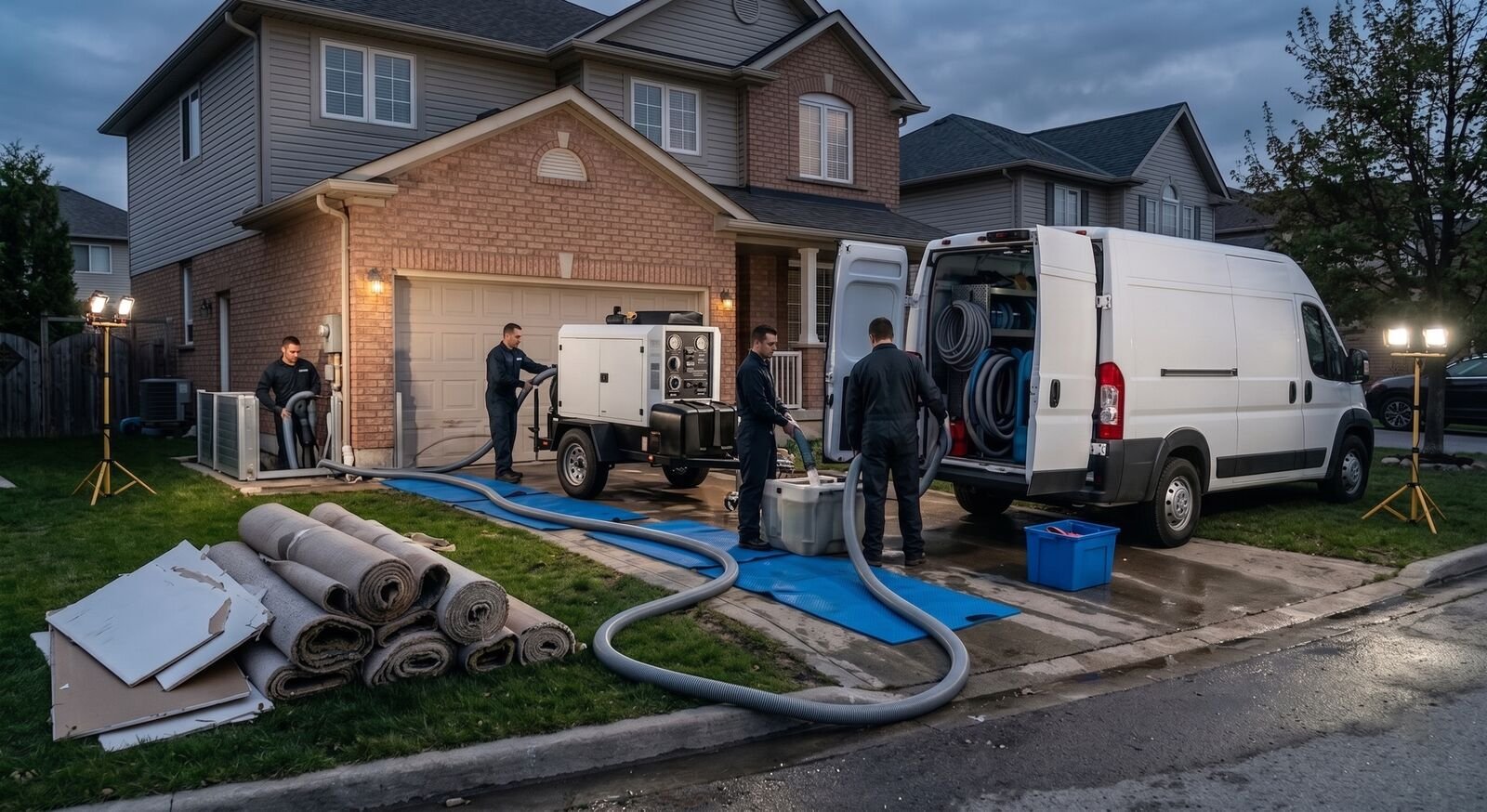
24/7 Emergency Water Removal · Denton County
Water Damage Restoration in Denton, TX
We provide water damage restoration in Denton, TX and 12 nearby cities, day or night. A live dispatcher answers, an IICRC-certified crew pulls out the water, dries your home or business to a measured standard, and handles the repairs and the insurance paperwork.
- Crew on site in about 60 minutes
- IICRC-certified technicians
- We work with all insurance carriers
- Free estimates
Water damage restoration Denton TX homeowners and businesses can count on
Water does most of its damage in the first 24 to 48 hours. Drywall wicks it upward, carpet pad holds it against the subfloor, and mold can start growing on wet materials in that same window. The faster the water comes out and the drying starts, the less you have to tear out and replace.
That is the whole reason we exist. We are a Denton-based water damage company that answers the phone 24/7, rolls trucks already loaded with extractors and dehumidifiers, and stays on the job until the moisture readings say the structure is dry. Then we put the house or building back together.
If water is on your floor right now, turn off the main water valve, keep people away from wet outlets and ceilings, and call (940) 274-9880. You will talk to a person, not a voicemail box.
Emergency checklist
What to do in the first hour after water damage
These steps limit the damage and protect your insurance claim. Do what is safe and leave the rest to us.
- First 5 minutesStop the water. Close the main shutoff (in most Denton homes it sits in a box near the street or where the line enters the house) or the valve behind the toilet, sink, or washer. If water is near outlets or a ceiling is sagging, stay out of that room.
- Minutes 5 to 15Cut power to wet areas at the breaker panel if you can reach it without standing in water. Unplug small electronics and move them to a dry room.
- Minutes 15 to 30Call us at (940) 274-9880. The dispatcher will ask what happened, how many rooms are wet, and whether the water is clean, gray, or from a sewer line, then send the right crew and equipment.
- Minutes 30 to 45Take photos and short videos of the water, the source, and damaged items before anything is moved. Your adjuster will want to see the loss as it happened.
- Minutes 45 to 60Lift rugs, furniture legs, and boxes off wet floors. Put foil or plastic under wood furniture feet. Do not use a household vacuum on water, and do not turn on the HVAC if it may pull contaminated air through the ducts.
- When the crew arrivesWe inspect, map the moisture, and start extraction right away. Call your insurance company when you are ready to open a claim. We can help with that call.
Not sure how serious it is? Our emergency severity calculator takes about a minute.
What we do
Restoration services in Denton and Denton County
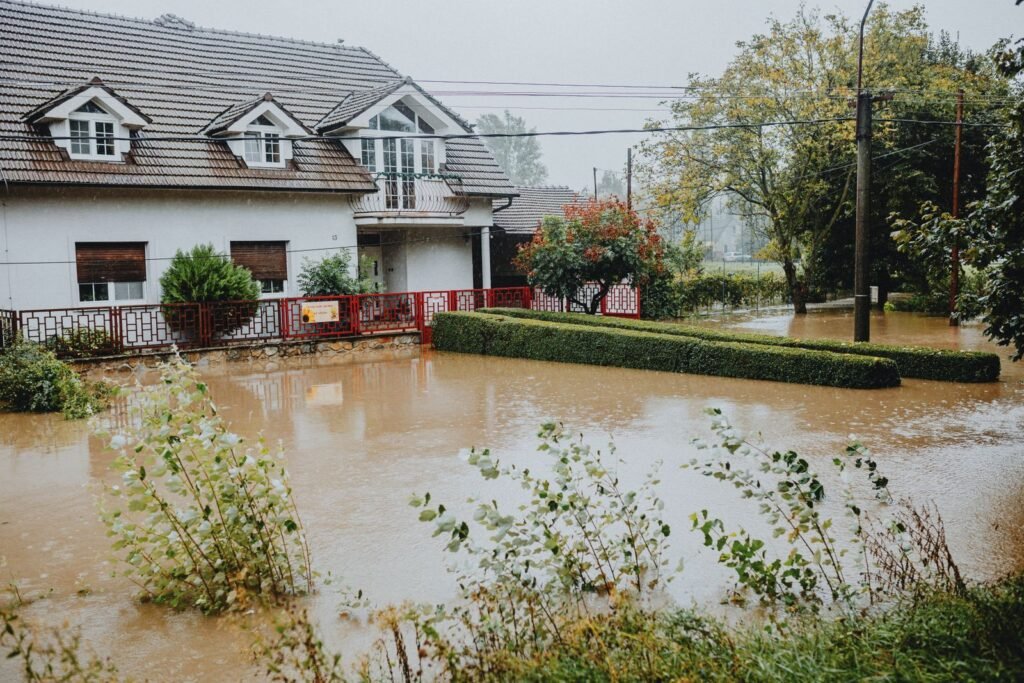
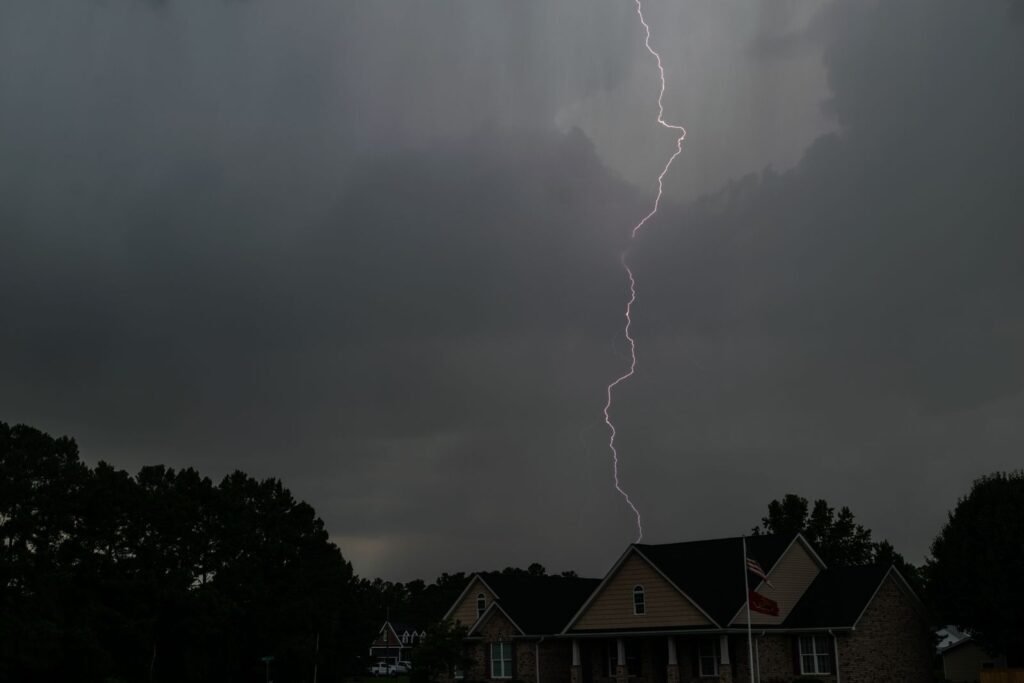
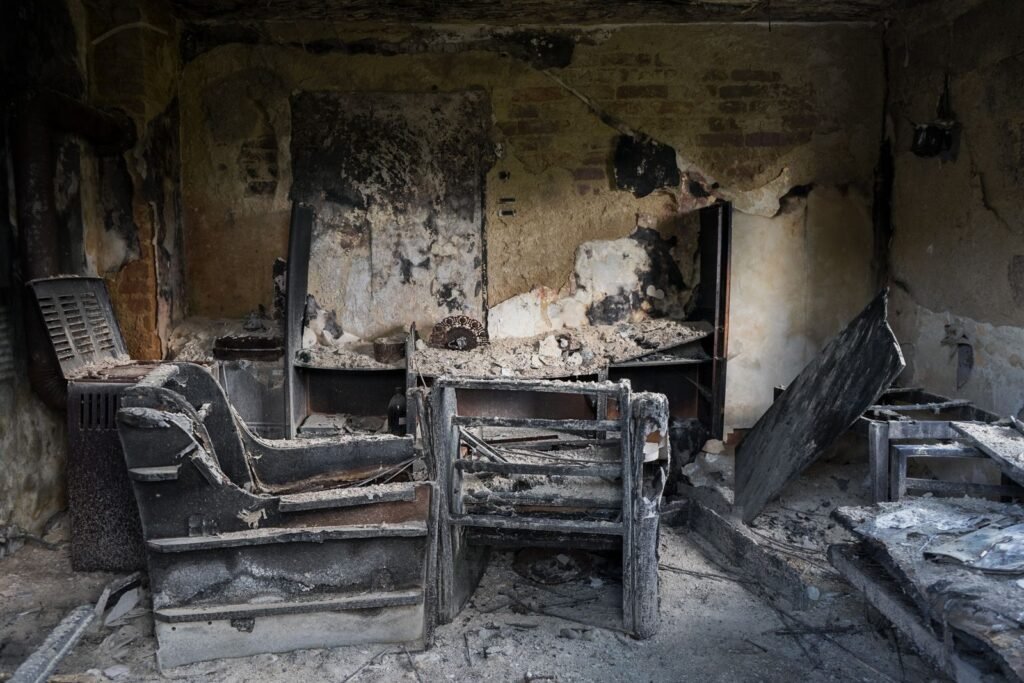
Water is our main work, and the same crews handle the fire, storm, and mold damage that often comes with it. Each service has its own page with details on timing and cost factors.

Local risk
Why Denton properties get water damage
A burst pipe is a burst pipe anywhere. But Denton’s creeks, weather, soil, and housing mix create a pattern we see over and over.
Creek floodplains
The City of Denton says its flood hazard areas sit mainly along Cooper Creek, Pecan Creek, North Pecan Creek, Hickory Creek, and Dry Fork Hickory Creek. Heavy spring storms can push runoff into low yards, garages, and slab homes near these channels.
Hard freezes
During Winter Storm Uri in February 2021, Denton lost water pressure below 20 psi in parts of the system and issued a boil notice. Many homes had broken pipes, and some waited days for parts. Pipes in exterior walls, attics, and garages are the usual failure points.
Hail and wind-driven rain
Spring hail is a regular event in Denton County, including baseball-sized hail reported in the Lantana and Bartonville area. Cracked shingles and skylights let rain into attics, and wet insulation can soak a ceiling before you see a stain.
Expansive clay under slabs
North Texas clay swells when wet and shrinks when dry, and ground movement of several inches a year is common. That movement stresses plumbing under slab foundations, which is one reason slab leaks show up as warm spots or damp flooring.
Rentals near UNT and TWU
With more than 55,000 students between the University of North Texas and Texas Woman’s University, Denton has a lot of apartments, duplexes, and rented houses. One upstairs overflow can reach several units, and owners and tenants need separate documentation.
Heat, humidity, and AC lines
Denton averages about 37.7 inches of rain a year and long, humid summers. Air conditioners run hard for months, so clogged condensate lines and rusted drain pans in attics are a steady source of ceiling leaks and mold.
Want the full picture? Read our guide to common causes of water damage in Denton and the flash flood risks in Denton County.
Houses, townhomes, and rentals
Residential water damage restoration
Most home water damage starts with a leak nobody saw coming. We treat your house like a job site and a home at the same time: floor protection, clear updates, and no surprise demolition.
- Burst and frozen pipes. Extraction, then drying inside walls with minimal cutting where possible.
- Appliance leaks. Water heaters, washers, dishwashers, fridge ice maker lines, and AC drain pans.
- Slab leaks. We dry the flooring and subfloor after your plumber finds and fixes the line.
- Roof and storm leaks. Tarping, wet insulation removal, and ceiling drying.
- Contents. We move, pack out, or block furniture so it stays off wet floors.
See residential water damage restoration for more on what a home job involves.
Offices, retail, schools, and multifamily
Commercial water damage restoration
For a business, every hour closed costs money. We plan commercial jobs around your operation, not the other way around.
- After-hours and phased work. We can dry one area while you keep using the rest.
- Large-loss equipment. Truck-mount extraction and enough dehumidification for open floor plans and warehouses.
- One point of contact. Property managers get a single contact and daily moisture reports for every affected suite or unit.
- Claim-ready records. Photos, moisture maps, and itemized estimates that support property and business interruption claims.
Learn more about commercial water damage restoration, or estimate what a closure could cost with the commercial downtime loss calculator.
How it works
Our 5-step water damage restoration process
The same method on every job, whether it is one wet bathroom or a flooded first floor.
Call and dispatch
A live dispatcher answers, helps you find the shutoff, and sends a crew. We aim to be there in about 60 minutes in most of Denton County.
Inspect and map
Moisture meters and a thermal camera show where water went, including inside walls and under floors. We classify the water category and the damage class.
Extract and remove
Extractors pull standing water from carpet, pad, and hard floors. Materials that cannot be dried or cleaned safely, like soaked pad or drywall hit by gray or black water, come out.
Dry and monitor
Air movers and LGR dehumidifiers run while we take readings every day. Drying ends when materials reach their dry standard, not when a timer runs out.
Repair and rebuild
We replace drywall, insulation, trim, paint, and flooring, so you do not have to hire and schedule a second contractor.
24/7 Emergency Line
Water in your Denton home or business right now?
Call (940) 274-9880. A live dispatcher answers 24/7 and sends a crew with extraction and drying equipment.
Tools and standards
Equipment and IICRC standards we work to
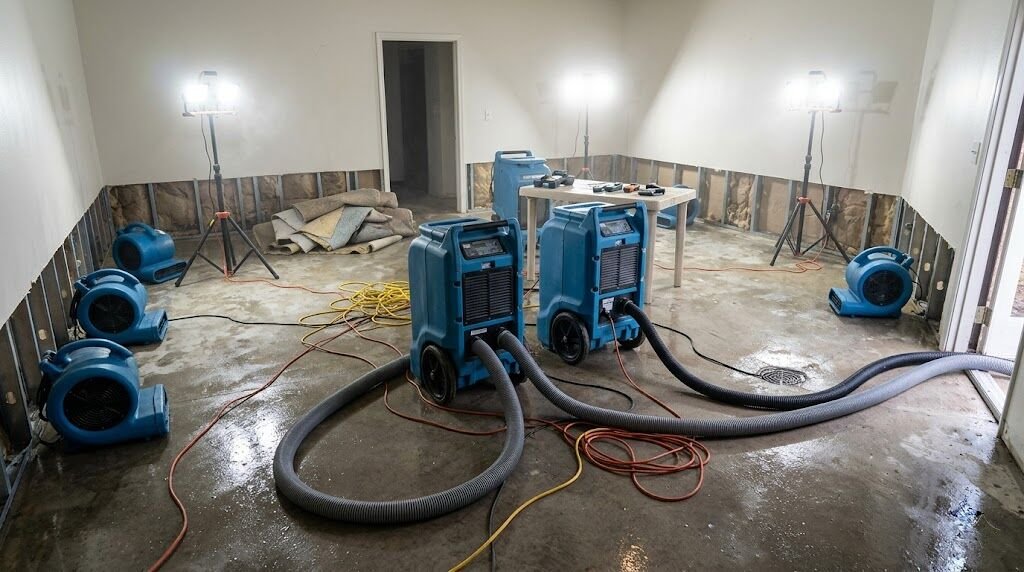
Our technicians are IICRC-certified and follow the IICRC S500 standard for water damage and the S520 standard for mold. In plain terms, that means we measure instead of guess.
- Truck-mount and portable extractors remove most of the water before drying starts, which cuts drying time.
- LGR dehumidifiers pull moisture out of the air even in humid Texas summers.
- Air movers push dry air across wet surfaces so walls and floors release water faster.
- Moisture meters and thermal imaging cameras find hidden water behind drywall, under cabinets, and below flooring.
- HEPA air scrubbers and negative air machines control dust and mold spores when materials have to come out.
Water categories
Category 1 is clean water, like a broken supply line. Category 2 is gray water, like a washer or dishwasher discharge. Category 3 is black water, like sewage or outside floodwater. The higher the category, the more has to be removed and disinfected. Clean water left sitting can degrade to Category 2 or 3 within a day or two.
Damage classes
Class 1 affects part of a room with little absorption. Class 2 soaks carpet and walls in a whole room. Class 3 usually comes from above and saturates ceilings, walls, and floors. Class 4 involves dense materials like hardwood, plaster, or concrete that need longer, specialty drying.
Insurance
Help with your water damage insurance claim
Coverage depends on your policy, and we never promise what an insurer will pay. What we can do is give your adjuster clear proof of what happened and what it takes to fix it.
- Often covered: sudden and accidental water, like a burst pipe or a failed water heater, under a standard HO-3 homeowners policy.
- Often not covered: rising floodwater (that needs an NFIP or private flood policy), slow long-term leaks, and sewer backup unless you added that endorsement.
- What we provide: photos, moisture maps, daily drying logs, and an itemized estimate in the format adjusters use.
- Adjuster visits: we can meet your adjuster on site and walk through the damage together.
We work with all major carriers, such as State Farm, Allstate, Farmers, USAA, Liberty Mutual, and Progressive, and we can work directly with your insurance company. For a rough idea before you call, try the insurance claim coverage estimator.

Know the difference
Water mitigation vs water restoration
You will hear both words from contractors and adjusters. They are two phases of the same job, and we handle both.
| Water mitigation | Water restoration | |
|---|---|---|
| Goal | Stop the damage from spreading | Return the property to its pre-loss condition |
| When | Right away, in the first hours and days | After the structure is confirmed dry |
| Typical work | Water extraction, removing wet pad and drywall, drying, dehumidification, antimicrobial treatment | New drywall, insulation, paint, trim, cabinets, and flooring |
| How long | Usually 3 to 5 days of drying | A few days to a few weeks, depending on materials |
| Insurance | Most policies expect you to take reasonable steps to prevent further damage | Usually paid on the claim estimate once the adjuster approves the scope |
Read more on our water mitigation page, including emergency water extraction in Denton.
Where we work
Service areas across Denton County and nearby
We are based in Denton and cover 13 cities. Arrival times are typically about 60 minutes in most of Denton County and can run longer to Carrollton and Coppell.
● Denton and west
Denton County · I-35, I-35W, US 380
Our home base and the towns off the I-35W corridor and the farm roads west of the city, from older Denton neighborhoods to fast-growing Northlake.
● Lake cities
Denton County · I-35E, US 380
Communities along Lewisville Lake, where lake humidity slows drying and many homes were built in waves of fast growth.
● South county
Denton, Dallas, and Tarrant counties · I-35E, SH 121
Larger suburbs south of the lake with a mix of 1980s homes, newer builds, offices, and retail centers.
See the full service area page for ZIP codes and local notes on each city.
Free tools
Free water damage calculators
Get a rough number before anyone sets foot in your home. These give estimates, not quotes, and a free on-site inspection is always more accurate.
Water damage cost
Estimate a cost range based on the rooms affected, water category, and materials.
Open the cost calculatorMold growth risk
See how time wet, temperature, and humidity change the odds of mold.
Check mold riskInsurance coverage
Answer a few questions to see whether your loss is the type policies usually cover.
Estimate coverageEmergency severity
Find out whether you need a crew tonight or can wait for a daytime visit.
Rate your emergencyCommercial downtime
Estimate what a closure could cost a business per day while it dries out.
Estimate downtime lossAll calculators
All five tools in one place, with notes on how each estimate is built.
View all calculatorsGuides
Latest water damage guides for Denton owners
What to do when your Denton home floods
A step-by-step list for the first day after a flood, from safety to photos to calling your insurer.
Read the flood guideWinter pipe burst risks in Denton homes
Which pipes freeze first in North Texas houses and how to protect them before the next hard freeze.
Read about frozen pipesHow Texas heat increases mold growth
Why humid summers speed up mold after a leak, and how fast drying keeps it from starting.
Read the mold guideMore articles on the water damage blog.
FAQ
Water damage restoration questions from Denton owners
How fast can a crew get to my property in Denton?
We aim to have a crew on site in about 60 minutes for most addresses in Denton and the rest of Denton County. Weather, traffic on I-35E or I-35W, and the number of calls during a big storm can stretch that, so the dispatcher will give you a realistic window when you call. Carrollton and Coppell typically take longer.
Will my homeowners insurance pay for water damage restoration?
It depends on your policy and the cause. Sudden and accidental leaks, like a burst supply line, are often covered. Rising floodwater, slow leaks, and sewer backup without an endorsement often are not. We document everything and can work directly with your insurance company, but the coverage decision is always your carrier’s.
How long does it take to dry out a house?
Most homes dry in 3 to 5 days once equipment is set up. Hardwood, plaster, concrete, and heavily soaked Class 3 or Class 4 losses can take longer. We take readings every day and only remove equipment when materials reach their dry standard.
How soon can mold start after a leak?
Mold can begin growing on wet drywall, carpet pad, and wood in 24 to 48 hours, and Denton’s warm, humid months speed that up. Starting extraction and drying inside that window is the best way to prevent it. If mold is already visible, we follow the IICRC S520 standard for containment and removal.
What is the difference between water mitigation and water restoration?
Mitigation is the emergency phase: removing water, pulling out ruined materials, and drying the structure to stop further damage. Restoration is the repair phase: new drywall, paint, flooring, and trim. Some companies only do one. We handle both, so there is no gap between the two.
Can we stay in the house during drying?
Usually, yes. Most families stay home while air movers and dehumidifiers run, though the equipment is noisy and some rooms may be closed off. If the loss involves sewage, floodwater, heavy mold, or no working kitchen or bathroom, staying elsewhere may be safer. Check whether your policy includes additional living expenses.
What causes most water damage in Denton homes?
The most common sources we see are failed water heaters, washer and ice maker supply lines, AC condensate overflows, frozen or burst pipes in cold snaps, slab leaks, and roof leaks after hail. Homes near Pecan Creek, Cooper Creek, and Hickory Creek also face runoff flooding in heavy storms.
Are your technicians IICRC certified?
Yes. Our technicians are IICRC-certified and follow the IICRC S500 standard for water damage restoration and S520 for mold remediation. That covers how we classify the water, where we place equipment, how we document drying, and when a job counts as dry.